Sunday, January 23, 2011

SIGNS OF CHANGE

            The temperature this morning dipped below 20°F for the first time, blowing a hole right through our heretofore Zone 9 winter and sinking us to Zone 8b. I do have to say, we haven’t felt much like Zone 9 since December anyway.

 
Tim and I actually got outside for a few billable hours at the end of last week. After eleven consecutive days of weather-enforced sitting around the kitchen/office—staring at the computer screen, completing too many Sudokus, crawling into bed late, dragging ourselves out of bed late, watching too many BBC cosy DVDs—an afternoon spent pruning and weeding felt like a commuted sentence (as opposed to a convoluted sentence, of which the foregoing is a prime example).


Oak Island's lowest
temp of the winter
of 2010-2011
             Although no one is trumpeting the arrival of spring in these parts—get real, it’s still January—subtle signs of seasonal change are out there if you pay attention.

            Days are getting longer. As of this posting, we have 19 minutes more daylight than in late December. More importantly, the sun comes up two minutes earlier than it did a week ago, and the pace accelerates from now on. It’s a miniscule change, but fraught with significance. Plants feel it, too.

            The constellation Orion has transited from the east (rising) to directly overhead (apogee) to the west (setting) when I go out for bedtime weather observations. (An astronomical aside: Along with Cassiopeia, the Pleiades and the Dippers, Orion is the only constellation I can reliably identify with any degree of certitude. Sometimes I think I know Leo—the bright red star Regulus marks his heart—and the teapot shape of Sagittarius. Sometimes I don’t. And, whenever I’m in the Southern Hemisphere, the Southern Cross is a no-brainer. I’ve always meant to devote more time to studying the visible stars: the problem is, you have to go out at night to do it. And then, there’s all that neck-craning. Wouldn’t it be useful if someone would just draw the lines and limn the faces?)


‘Tête-à-Tête’ daffs
are coming
             Tips of the ‘Tête-à-Tête’ daffodils that live near our front door have poked their hard green noses out of the mulch. In other yards, other daffs are stirring. Fine-bladed foliage of starflower (Ipheion uniflorum) and Crocus tommasinianus makes the front bed along the sidewalk look like it needs weeding. Tim spotted what we think might be a redbud (Cercis canadensis) flaunting a set of red buds (duh) at the tip of a branch. Bradford pear buds are swelling. We have buds, or maybe they’re flowers, on our Edgeworthia chysantha (paperbush), but I can never tell what’s up with them. They always look slightly embarrassed and mildewy to me.

            The very earth, when you get your nose near it, smells expectant. The angle of the sun is higher. Everything outside feels itself on the verge of something wonderful.

            Yesterday morning, my eponymous follower, Cathy Fitzgerald, sent me the new post from her site, EcoArtNews. I scrolled back through some of her earlier pages and stumbled on a charming video snippet of Wangari Maathai telling her hummingbird story. For those of you who have never heard of her, Ms. Maathai is the founder of the Green Belt Movement, a program aimed at combating deforestation, desertification, rural hunger and water crises in Africa through the empowerment of women. She persevered despite political persecution and personal setbacks to win the Nobel Peace Prize in 2004. It’s nice to know that occasionally the recipient has actually done something to deserve it.

            I’ve included a link to the hummingbird story. In keeping with my theme of little changes, we can all choose to be hummingbirds.

          
               Today’s is a short post. On Tuesday, Tim and I are off to the Really Big City—Raleigh—where I have arranged an interview with the director of the Plant Disease and Insect Clinic (PDIC) at North Carolina State University and a tour of the lab for an article about the PDIC’s services (that will appear in the June issue of Carolina Gardener magazine). As part of their land-grant-college mandate, the Clinic will identify your bug or disease—free for pictures, but they have to charge for mailed-in samples—and suggest environmentally responsible control measures. I used the service for the first time last summer for an invasion of baby army worms on my wax beans… except I didn’t know they were army worms until the entomologist-on-call got back to me via email with 24 hours. 


Norman Rockwell's
"Triple Self-Portarait"

This is our first road trip in a while. We plan to take in the Norman Rockwell exhibit at the NC Museum of Art, and expect to come home feeling all gooey about our 1950s childhoods. But I need the rest of today and tomorrow to prepare (for the interview, not Norman), so I won’t come off as a total blithering idiot. I’ve been out of Academe so long, I sometimes forget to not be intimidated by it.

Can’t believe it’s almost time for the January Wrap-up. Where does the time go?

By the way, Tim added two easy ways to subscribe to this blog, by a search-engine reader and by email. The simple-to-click options are on the sidebar at the top of the post, above the profile.

Thanks for dropping by. Y’all stay warm.

                                                                                Kathy


Thursday, January 20, 2011

COMPOST HAPPENS II

           Old stone to new building, old timber to new fires,
           Old fires to ashes, and ashes to the earth
           Which is already flesh, fur and faeces,
           Bone of man and beast, cornstalk and leaf.
                     T.S. Eliot, from “Burnt Coker I,” Four Quartets

So what do I have to do to get you into composting today? 

Gardeners Supply's
compost bins Models 1 & 2...

There’s a lot of composting info-opportunities accessible to the curious. I conducted a casual cyber-survey by typing “composting” into the Google search box. In seconds, I had 12,500,000 results. That’s twelve-and-a-half million listings.

Narrowing the field a bit, I typed “composting” into Amazon’s books search bar. Five hundred ninety-six titles are available. I’ve already read two of them—only 594 to go.

Feeling myself on a roll, I upped the ante and typed in “composting supplies” while still at Amazon. Almost 200 sites vie to sell you something to turn your garbage into soil food. (And skillions more want to suck you into a black hole of disengagement from real life.)

A sad fact of modern life, too damn many pseudo-choices effectively paralyze those who get sucked into the maelstrom. My life-long quest for simplicity has yielded a few pertinent insights on the subject: 

1)      If an activity seems complicated, riddled with rules, and/or oozing with experts’ advice, most of us won’t advance past the cursory investigation stage. I mean, how many of those 12,500,000 sites would you click on before your brain reverted to dial-tone? (I only got to three.)

2)      If an activity, once started, appears to cost too much—either in money, time, or psychic resources—most of us will find a way to weasel out of it… regardless of how much money, time or psychic energy the extraction requires. For example, think of all those exercise bikes, treadmills and bow-flex systems languishing at garage sales everywhere.

...and bins 3 through 7,
a worm composter
(not for composting worms)
and accessories
3)      If, however, an activity becomes enjoyable for its own sake, the putative rewards dangled to hook us in the first place begin not to matter. That’s when an activity becomes a part of who you are.

A depressing corollary to the above list is that most of us expend far more energy on 1) and 2) than on 3).

Should you decide to take a figurative plunge into compost, I can testify the literature is full of rules. First and foremost, compostable candidates must fall into one of two color-coded categories. Kitchen scraps, grass clippings and non-woody garden debris—you know, the moist, green stuff—are called greens. Material with higher carbon content, like dead leaves, twigs, shredded newspaper and used paper towels, are browns. Mavens expound upon involved formulae for proper layering techniques to maximize a pile’s performance. There are also very specific heat, air and moisture requirements to be maintained. In fact, the many rules and criteria for constructing an ideal composting environment almost convinced me to forget the whole thing. (I do not play well with authority.)

Oh, yeah? I bristled to myself. We’ll just see about that.

Through trial and error, I proved the rules are all pretty much unnecessary. Nature never takes the advice of experts. Nor do experts read Eliot, apparently.

Gardens Alive!
compost tumbler system
and thermometer
In my own practice, I do everything “wrong.” My greens and browns go on the heap in the same order they come out of the kitchen and yard without regard for proportions or layering. I cavalierly toss in bits of cheese, cat-brush leavings, ashes from barbecued income-tax records, baked goods, threads and scraps of material (yes, I mend clothes!), the contents of our paper-shredder bin, past-its-prime yogurt, used-but-un-disease-ridden potting soil, and, on rare occasions, unfit-for-human-consumption cold cuts: this despite dire warnings, threatening vermin and stink, against dairy, sugar, meat and non-soy inks and dyes. My bin is not optimally located either for sun exposure (it’s shaded most of the day) or protection from overhead watering (the south-side spray-heads douse it twice a day in summer), so prescribed levels of oxygen are, pardon the pun, dampened. I’m lacksidaisical about ensuring the cooler edges of the pile get folded into the hotter middle to equalize the “cooking” process: all I do is stand at one end of the bin, stab and flip four or five pitchfork-fuls, move to the other end and repeat.

My stuff—all of it—still composts. It resembles dirt. I have earthworms. There’s no noticeable unpleasant odor (believe me, Tim the Nose would notice and remark).

Kitchen scrap buckets galore
from Gardeners Supply...
For the sake of argument, let’s say you’re not as, er, flexible about rule-following as I am. You can participate in the composting process as much or as little as you like, depending on how compulsive, impatient and/or controlling you are. Type A personalities with money and time to burn might purchase a pair of those big, multi-chambered tumbling barrels for the quickest alleged turnaround time between garbage and good stuff. A moderately obsessive approach consists of some arrangement of multiple bins for shifting piles back and forth, ostensibly to maximize aeration and temperature, allowing you to think you’re speeding up the process. (I’ve provided pictures of available ready-mades from Gardens Alive! and Gardeners Supply catalogs.) The laissez-faire-minded—such as myself—can just dump their biodegradable detritus somewhere inconspicuous and let it decompose. Left to their own devices, microbes and earthworms magically appear and set to work breaking down garbage into crumbly, rich, non-stinky soil.

Truly, the smell is not bad; exceptions can be dealt with quickly by turning them under. (The most malodorous product I know of is Milorganite, which is not composted anything, but treated industrial sludge. Beware those heavy metals!) Once composted, even manures don’t reek.


...and still more
scrap buckets and accessories

Speaking of which, herbivore manure is always a welcome addition to the heap. (Of course, not everyone agrees. Soil gurus Lowenfels and Lewis caution against it in compost destined for edible crops. That’s just a tad too “perfectly safe” for me. But they live in Alaska, which probably explains something.)  My friend Christine has access to unlimited quantities of llama dung, of which I am darkly envious. Short of keeping small herds of bovines, ovines or equines and/or flocks of chickens, turkeys or bats—or having friends who do—most of us totter on without. It’s why the gods invented Black Kow and Daddy Pete’s.

An environmentally responsible and productive activity, composting reduces burdens on overflowing landfills while allowing us to benefit from direct recycling of some of the immense quantities of waste we generate. Despite all the print and cyber hype, composting doesn’t have to end up on the dust-heap of abandoned ambitions along with bread machines, cross-country skis and all those bizarre paper-punches scrapbookers covet. Why not? Because, if you let it, compost just happens.

Did you notice Tim updated the site’s template? And I posted a new profile picture, of me and Tim at four, 1958 and 1954, respectively. We were awfully cute in those days. Please leave a comment if the spirit moves you. Or perhaps the comment-shy (and so far, that’s damn near all of you) can visit “Gardening Gone Wild” (www.gardeninggonewild.com) for inspiration. It’s a WordPress blog I stumbled upon where garden writers write for other garden writers and we all tell each other how wonderful we are. I’d sign up to follow it, but I don’t understand RSS.

I shall move on to other pastures next time. Thanks for dropping by.

                                                                            Kathy

Sunday, January 16, 2011

COMPOST HAPPENS

          Compost is the soil-enriching end result of the decomposition of vegetative products. For gardeners, managing a compost pile is a way to reconnect to the cycle of decay and rebirth that humans work so hard to deny we’re a part of. How does compost differ from rot? It doesn’t. It’s just carbon-based shape-shifting, like ice into water into steam. Over time, today’s potato peels and paper towels and that last scoop of macaroni-and-cheese morph into beneficial bacteria- and fungi-loaded humus. It’s quite miraculous, really.

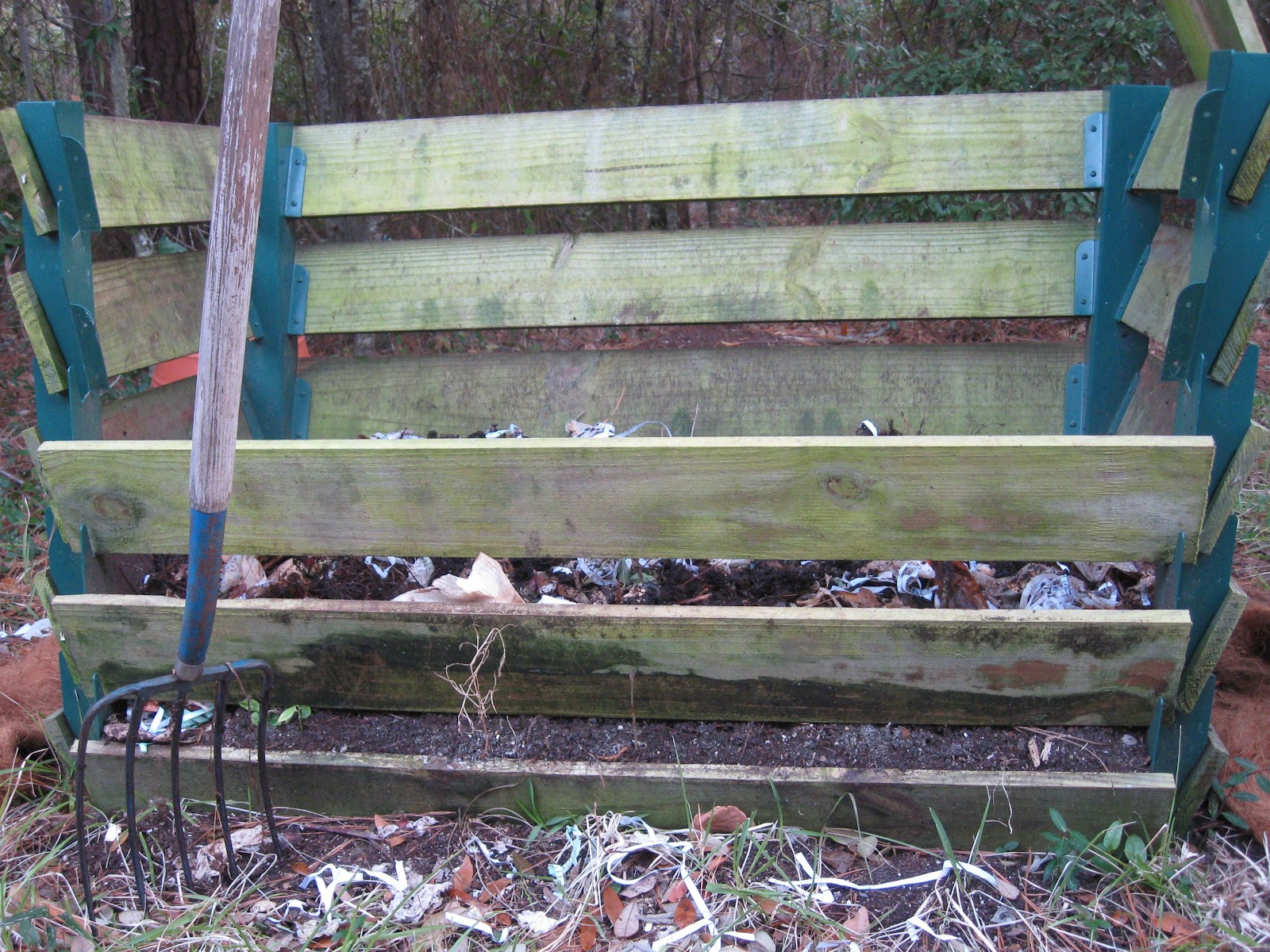
The basic Fitzgerald compost bin
flanked by their basic pitchfork

I am definitely not advocating flinging today’s kitchen scraps or freshly produced manure around your yard: that would just stink, attract vermin, appall the neighbors and burn your plants with too much nitrogen. You need to keep the stuff corralled and let it age for a while. Like so many other aspects of gardening, it doesn’t pay to be in an almighty hurry.

You’d think it would be easy to convert your non-synthetic kitchen and yard leftovers into soil-building material. That’s what I thought, anyway, many years ago when I never missed an issue of The Mother Earth News. The world was young then, the possibilities seemed endless.

Why not build a couple of bins and start composting? I asked my then-husband, R. He shrugged. He didn’t care what I did as long as I stayed home. We cobbled together a sort of M-shaped pair of square-ish spaces with removable fronts, for easy access. To collect kitchen detritus, I got a green plastic bucket from some upscale mail-order company, complete with tight-fitting lid topped by a replaceable charcoal filter. We already had a garden fork. So, for about 40 dollars and a few hours with a hammer, I was in business.

The Fitzgerald compost bin
with front top boards removed
for easy access
            I lived in the foothills of the Adirondacks in those days, in a lovely 1930s Cape Cod with a cedar-shake roof and a rear-facing garage. This is not gratuitous description: it’s an important brick in the wall of my composting education. We’d positioned the bins at the back of the 25-by-35-foot rectangle of asphalt that made using the garage possible. This arrangement worked great June through October (what the locals called spring, summer and fall). Once snow started falling, however, whatever collected on the driveway and the turnaround had to be rearranged so R could get the Honda out. By Christmas, I was clambering over drifts higher than my head to make deposits to the by-then-frozen-solid compost pile. (On the plus side, the mountainous snow heaps made it much easier to reach the roof, which, because it was wood, needing raking to prevent the living-room ceiling from becoming the living-room floor. Like I said, I was young at the time.)

            Pregnancy brought an end to death-defying trips over the drifts during the third exhilarating season. I traded in my The Mother Earth News subscription for Parenting.

Eternally odorless
stainless steel
kitchen scrap bucket

            Earth orbited the sun nine or ten times; I moved to a more hospitable clime. I decided to try composting again. After Tim and I installed Incarnation #1 of our garden here in NC, I bought one of those black-plastic, tapered, barrel-like composting “systems.” (Why? Because it was small, and space is limited chez Fitz.) We anchored it down on the sunniest part of the back yard and began filling it enthusiastically. Soon it reached capacity. That’s when the trouble started. The barrel’s narrowness made getting a pitchfork in to turn the stuff annoying, but I persevered. However, when I opened the little door at the bottom to extract the first load of home-grown “black gold,” I discovered about a jillion fire ants had made the snuggy-warm compost pile their home. Oh, dear.

            We eventually persuaded the ants to change their address. By the time the barrel could be approached without threat of grievous bodily harm, I was already whining about lack of space to plant. I gave the “system” to an unsuspecting friend, and installed a vegetable garden. 
     
            A few years after the final fire-ant bite had drifted into scabby memory, I resolved to try again, again. Maybe three’s the charm, I thought. Worked with husbands. I listed everything that hadn’t worked before, the better to avoid repeating mistakes.           

Unturned compost

            Composting Lesson #1: Location, location, location. Year-round accessibility to the pile is very important. If you live in a harsh-winter area, siting your bins in a sunny area protected from wind is also a good idea. Arranging for your children to be born in August or September is something else you may want to give serious thought to. Here in the Southeast, that part’s not so important.
            
            Composting Lesson #2: Plastic scrap buckets—no matter how upscale, no matter how often you change the filter—eventually start to smell. Over time, the faint but pervasive odor of rotting food wafting about the kitchen is enough to disenchant the earthiest of earth-mothers. Stainless steel is the only sensible way to go for the long term.

            Composting Lesson #3: Keep the drill as simple and convenient as possible. Know thyself and thy limitations. And avoid any commercial product that bills itself as a “system.” “System” is ad-speak for “More Trouble Than It’s Worth.”
Recently turned compostables

            Now I have a 2-by-6-foot louvered box, made with 1-by-6-inch planks screwed into mail-ordered metal corner-posts. This receptacle takes select garden debris (nothing too big, diseased or potentially invasive, like Ruellia caroliniana seeds or wild garlic bulbs) and loads of kitchen scraps from my lidded stainless-steel bucket. After emptying it, I fill the bucket with water from the rain barrel, swish it around and douse the pile. Once a week, usually on Sunday walkabout, I give the pile a turn. All in all, it’s a pretty laissez-faire operation, perfectly suited to my personality. Two years of kitchen and yard waste have shrunk to an eight-inch-high pile of odorless dirt, teeming with microbes.

Home-made "black gold"

The only fly in the ointment is that, as yet, none of this good stuff has made it into the garden, which is why I’m still moaning about hauling around 50-pound bags of Black Kow.

What’s the problem? you ask.

Turns out I need a second bin. The stuff in the original bin can’t fully cook down because I keep adding to it. I keep telling myself, Next paycheck I’m ordering more corner-posts. Maybe next paycheck I will.

I find I have more I want to say about composting, so I will, next time. Thanks for dropping by.

                                                                          Kathy

Wednesday, January 12, 2011

MAKING CONNECTIONS

            This past Monday, two disparate but dovetailing print snippets caught my eye. The first, from the Wilmington, NC, StarNews, was about a lawsuit brought against one of the area’s industrial hog farms for “…persistent dumping of hog waste into” the Neuse River watershed. The second was the epigraph to Chapter 12 of Greg Mortensen and David Oliver Relin’s Three Cups of Tea, which details Mortensen’s struggles to build schools in the Baltistan region of Pakistan.

            You connected pig poop with Pakistani schools? you ask.

            Well, yes. Read on.

Hog-waste lagoon
flooded by 1999's Hurricane Floyd

            Problems with hog waste disposal are not new to eastern North Carolina. Typically, the tons of pig excrement produced by concentrated animal feedlot operations (CAFOs) is collected, thinned with water, then stored in huge above-ground structures euphemistically called “lagoons.” There is currently no environmentally sound or commercially feasible use for the noxious slurry. Mostly it leaches into the ground. Eventually. A rumor persists that the USDA has research teams working around the clock to alchemize this crap into some kind of gold. Be that as it may, during the epic flooding caused by Hurricane Floyd in 1999, dozens of lagoons breached, inundating acres of land and tributaries of the Cape Fear and Neuse Rivers with skillions of gallons of the stinky stuff, an environmental disaster downplayed with great skill by local media who know on which side their bacon is buttered.

Arguably, it’s one thing when the powers-that-be can blame an act of god. It’s something else entirely when CAFOs regularly thumb their noses at the federal Clean Water and the Resource Conservation and Recovery Acts. Industrial agriculture, like Wall Street, Big Business and the NRA, calls the shots, because our elected “representatives” are willing to sell their souls and our futures to the highest bidder just to stay in office.

Well, enough political rant. It just gets me all het up, raises my blood-pressure and serves no useful purpose beyond venting. The frustration itself remains.

The second bit of print that sparked this diatribe speaks to what we, as individuals, as gardeners, can do in the face of the Big Boys. (This is where Pakistan comes in.) Attributed to Helena Norberg-Hodge, founder and director of the International Society for Ecology and Culture, the epigraph that caught my eye goes like this: “…our search for a future that works keeps spiraling back to an ancient connection between ourselves and the earth.” (Emphasis mine.)

Helena Norberg-Hodge
The continuing hog waste debacle, and how profit for the few trumps the well-being of the many, got me thinking about synthetic fertilizers. Connections!

Let me tell you a story.

Until the end of World War I, farmers everywhere used only composted manures, kitchen-and-garden wastes, and seaweed to amend their fields. That’s all they had. Recycling wasn’t some hippie-tree-hugger pipedream, it was both an economic necessity and the only course of action that made sense. Once hostilities ceased in 1918, however, armaments manufacturers faced severe income losses. Some bright soul, probably noting the lush plant growth at his factory’s out-flow, figured out that the same ingredients used to make big booms—nitrogen, phosphorus and potassium—also enhance crop performance (kind of Timothy McVeigh reasoning in reverse). Tim says he can almost see the foremen on the packaging floors yelling “Stop!” and manhandling big valves closed, bringing the clattering lines to a stand-still. They produce bags and boxes with different, unwarlike labels, and install them on the filling machines. “Okay, start ’er up!” they cry while reopening the valves.

Toss in an aggressive marketing campaign, and day dawns on the commercial fertilizer industry.

Better living through chemisry...

Crop yields rise dramatically the first several years. But over time, so do pest problems and soil depletion. (Can you spell “Dust Bowl”?) Why? The new, “chemical” plant foods come formulated as salts that, once in the soil, have to break down in the presence of water before their nutrients are available to plants. The salty by-products of this reaction don’t magically disappear from the soil: they accumulate. Exposure to excessive salt causes the soil microbiota that form the base of our food chain to dehydrate and die. That’s why, once you start using synthetics, you have to keep on using them, and more of them, because their mode of action essentially renders the “fertilized” soil sterile.

The whole concept seems rather stupid when put that way, doesn’t it?


...and gene splicing
Eager to accelerate the environmental mess they'd fomented, the armaments guys—now with names like DuPont, Bayer Crop Science, Monsanto, Dow Agrochemical, Scotts, and Ortho—got into the pesticide business as well. Now they could poison fish and birds and whole ecosystems as well as bacteria and fungi. Bottom lines burgeoned.

Okay, I’m being a tad over-dramatic here, but you get the idea. Taking the non-blame-laying path, one could say the early days of “Better living through chemistry” had myriad unintended consequences. Anybody out there besides me old enough to remember DDT and Rachel Carson? I’m just not too sure about the “unintendedness” of the consequences of agri-business practices today. The politics of genetically modified organisms, especially the ones we eat, is a subject for another day.

Soil science made understandable
The point of all this is, as gardeners in our own little yards, in our own community gardens, on our own town’s streets and medians and parking lots, our first responsibility is to the soil. Without healthy, living dirt, ultimately we got bupkis.

For me, the eureka moment came during a class on soils Tim and I attended, opening my eyes to the notion of feeding the soil instead of the plants. Then I read Teaming with Microbes: A Gardener’s Guide to the Soil Food Web by Jeff Lowenfels and Wayne Lewis (see “Good Reads” on the sidebar). The obviousness of how everything in nature connects moved to the forefront of my consciousness. "Never send to know for whom the bell tolls," John Donne warned centuries ago. "It tolls for thee."
 
Biodegradable BioBags
 I started a compost pile. We've reduced the amount of garbage set out on the curb each week to one bio-bag of dry stuff: the rest we turn into food for our dirt. I stopped buying fertilizers with high N-P-K numbers. I cadged shredded leaves from a client to use as mulch (he was going to throw them out!). You already know I remove weeds by pulling them. When it comes to pests, I practice prevention: right plant, right place makes a lot of difference. When damage exceeds acceptable limits, control starts with mechanical means—a jar of soapy water, the bottom of my shoe, transportation to the birdfeeder—or with low-residual-impact products like insecticidal soap and horticultural oil. We installed rain barrels. Tim uses an electric lawnmower. And the lawn gets smaller every year as I add new beds.

There’s no point in hand-wringing and moaning about not being able to make a real difference. No, we’re not going to bring the military-industrial complex to its knees by practicing sane horticulture on our little patches… not in this century, anyway. But we can change our attitudes. Little connections become clear, little adjustments follow.

“Only connect!” E.M. Forster exhorts us in Howards End. “Live in fragments no longer.”

Couldn’t have said it better myself.

Thanks for dropping by. Wanna hear about my adventures in composting next time?

                                                                                                    Kathy

Saturday, January 8, 2011

RANTING AND RAVING

            On Wednesday of this week, Tim suggested I practice what I preach and become a follower of a few other gardening blogs. I demurred (remember the depression my scroll through www.digindirt.com caused? If you don’t, it’s detailed in the “Bits and Pieces” post of December 2). He gently persisted, patiently leading me through the mechanics of locating lists of the gazillions of relevant sites, enthusiastically extolling the many advantages of linking to other people’s natterings, and having them provide links to mine. I am easily overwhelmed when it comes to the WorldWideWeb. A headache started tickling my temples. As my eyes glazed over, Tim quickly clicked to “A List of 50 Top Gardening Blogs by Blog Rank” to circumvent the imminent trance-state.

             I snapped to, for a little while. The site ranks the top 50 gardening blogs, all right… by 20 different criteria (some of which I actually understood) and in ten different lists. That’s only 500 possibles to reduce to two or three that I might enjoy following. Kids’ stuff, right?

A graphic representation
of how I feel about finding
other blogs to follow,
by Edvard Munch

            Insert primal scream here.

            Some of the site names seemed familiar, so I opened the one that had most intruded onto my consciousness. That would be the venerable “Garden Rant.” The lead post was one of the four founders whining, in very choppy sentences, about the fate of the citrus trees she’d brought inside for the winter. I sympathize—my own experience with houseplants suggests she may be a kindred spirit—but there was so much other stuff going on I got distracted. Extensive sidebars flanked the text on both sides, minimizing it. Animated ads; plugs for products, books and green political action groups; author bios; accolades from print sources; paeans from devotees; long lists of followers, sponsors and indexed topics; contests; awards announcements; and more detracted from what I, passé idiot that I am, had supposed to be the point of garden blogging. 

            Call me old-fashioned, but there’s got to be a less strident way of communicating. Is it no longer possible for like-minded people to have a quiet online exchange of ideas without one or both of them trying to sell the other something?

            By Friday evening, searching for possible-soul-mate bloggers felt like pouring time down the toilet, by the gallon. You may remember my status as a neo-Luddite (see “My Blog and Welcome to It” of November 4, 2010). I do not now enjoy nor have I ever enjoyed surfing the Net. Way leads on to way, sites are difficult (for me) to navigate, clicking and clicking and clicking to no useful purpose. I’d almost rather be cleaning the house. I’d certainly rather be writing.
An official Garden Rant blog logo


             Nonetheless, because I have a stubborn streak the breadth of Montana, and because I love my husband very much and want to please him, I stuck with it for several hours over multiple sessions. What follows is the upshot.

     1.  Many bloggers apparently have no surnames. Others have no Christian names (or whatever religion—I’m a lapsed WASP and it shows), only what can best be described as aliases, often preciously misspelt. This reticence to state-your-name raises red flags for me. What are they hiding? Or, alternatively, what are they hiding from? Are they ashamed? Are they promulgating lies? Are they Ted Kaczyinski clones or Raelians? Are they members of a Witness Protection Program? Sure, I have deep-rooted trust issues when it comes to cyber-space, but, by golly, if you know my name you’d best be prepared to tell me yours.

2.      Plenty of the sites I visited are unattractively aggressive about extolling the virtues and/or products of the writer. Of course, personality shines through all non-fiction writing (I specify non-fiction because I devoutly hope Stephen King’s output doesn’t open a window onto his soul): but relentless self-promotion sets my teeth on edge. Could I be envious of bloggers like Amy Stewart, whose blog “Dirt” trumpets Amy's publishing triumphs, Amy's indie bookstore, upcoming media events starring Amy and links to New York Times articles featuring Amy? Absolutely. But my Southern upbringing militates against the virtual equivalent of balancing on one foot atop a roof peak shouting, “Look at ME! Look at ME!” Call it a 21st-century character flaw.

3.      Some sites I clicked and clicked and clicked through and rejected:

·         “Sustainable and Urban Gardening” by Susan Harris, one of the founders of “Garden Rant” and a suburban Washington, D.C., garden coach, a self-bestowed title that rated an immediate black mark in KathyWorld. In my opinion, “coach” is a term reserved for sports, not life, and definitely not gardening. Do we also have gardening cheerleaders? (That’s a rhetorical question. I fear the answer.)

·         “GardenGateBlog” by I-don’t-know-who. This one’s a navigation nightmare. Dozens of clicks got me confused, fast.

·         “This Garden Is Illegal” by Hanna in Cleveland. Aside from having no last name, Hanna committed the unforgiveable sin of using “peaks” when she meant “piques.” Gave me shudders.

·         “A Gal Growing Southern” by Nelumbo out of Savannah. Intrigued because Tim and I love Savannah, the lack of positive ID and the precious “Gal” of the title got this one a thumbs-down. Must we all be cute all the time?


Many thanks to Mr. McPherson

Despair not—despite the stringent requirements, I found some sites to follow. There are probably many more, but my tolerance ran out for winnowing the kernels from the enormous amount of chaff that fills the blogosphere. Plus, we really, really have to take down the Christmas tree today, before we make the Nargleys' tradition our own (many thanks to Mr. McPherson).

I really liked Noel Kingsbury’s “Noel’s Garden Blog.” He writes from Hay-on-Wye in the Welsh border country of the UK, and snarkily referred to “organic jihadists” in his profile. That and the beautiful lead-picture garden hooked me, and I pledged to be a faithful follower, even if it means spending more time in cyber-space.

I would also like to sign on to the androgynous M. Sinclair Stevens’ “Zanthan Garden,” out of Austin, Texas. Alas, her (his?) weblog is not friendly to point-and-click following, but he (she?) lists her (his?) email address—all in words, no symbols, an endearing trait—so I shall contact him (her?) directly and hope I don’t end up a victim of her (his?) spam filter.

Lead photo from
Noels Garden Blog
(he left out the apostrophe, not me)
 Finally, I subscribed to Cathy Fitzgerald’s (cool “coincidence” about the name, eh?) EcoArtNews site. We share interests in trees and conservation, as I found out when she signed up to follow me yesterday. There was great rejoicing in Oak Island, I can tell you, that someone I don’t actually know—and from Ireland, no less—finds “Gardening from the Ground Up” follow-worthy. Cath even left a comment after the “Winter Weeds” post, as inspiration to the rest of you.

Please feel free to suggest other blogs you think might meet my criteria of full name disclosure, a firm grasp of the intricacies of the English language, no hit-you-over-the-head selling, and ease of access. Please feel free to make any suggestions, about anything at all. Please feel free.

Thanks for dropping by. I’m turning off the computer now. See you next time.

                                                                      Kathy