 |
| Welcome to Gardner Hall' home of the PDIC |
Had a marvelous time at North Carolina State University in Raleigh last Tuesday. Everyone Tim and I met in the plant pathology department was lovely, if a little twitchy at being interviewed. Tighter funding for institutions of higher learning translates to smaller pies to be divided between competing academic interests: the threat of downsizing may have contributed to the hint of reticence we felt. One poor fellow we snuck up on in the lab looked absolutely terrified when we asked him to tell us which plant disease gets reported to him most often.
As noted elsewhere, I’ve been out of the academy for some time, and am less sensitive to the nuances of life in cubicles and labs than I might have been years ago. I would like to take this opportunity to apologise for upsetting the gentleman who only wanted to be left alone to get on with his work.
And fascinating detective work it is, too. Nancy Drew and her gang could learn a thing or two from the men and women poring over the samples of sick plants and healthy bugs pouring into NCSU’s Plant Disease and Insect Clinic (PDIC). They come from all over the state (and occasionally beyond), farmers and commercial growers and Extension agents and Master Gardeners and homeowners all needing positive identifications and suggestions for control. Clinic director Dr. Barbara Shew and Mark Abney, assistant professor of entomology and Extension Specialist, gave generously of their time to answer all our questions about the mechanics of diagnosis and prescription. The bulk of their labor is directed toward agricultural and commercial interests, but do check out my up-coming article in the June issue of Carolina Gardener to learn how they can help Joe Homeowner figure out what’s eating his collards or marring his ligustrum foliage. (Hint: it’s not ground pearl.)
 |
| Samples inundate the PDIC lab |
Two other elegant factoids about NCSU and plant pathology before we move on:
1. NCSU is rated one of the top five university entomology research departments in the whole country. Go, Wolfpack!
2. Because agriculture in North Carolina is so diversified—top cash crops include tobacco, cotton, soybeans, corn, peanuts, sweet potatoes, apples and, hey, dude, marijuana—our guys have a broader base of knowledge than their counterparts at, say, Iowa’s land-grant universities, who deal primarily with corn and soybean problems.
Tim and I spent the rest of our day in Raleigh at the NC Museum of Art, taking in the excellent Norman Rockwell exhibit. We were among the youngest of attendees not dragged there by parents or grandparents, which was gratifying. (As one’s birthday-tally mounts, one finds oneself counted as youngest anything an increasing rarity.) Tim paints, so he wandered off to scrutinize brushwork and composition and such-like. I gravitated to the collection of all 339 Saturday Evening Post covers Rockwell contributed between 1916 and 1963, some of which I vaguely remember arriving through our front-door mail slot in 1960s suburbia. Crowds collected in clumps in front of the covers display. Fortunately, the advanced average age of the gathering meant most had some notion of museum etiquette. (I’ll never forget the lady at a Met exhibit of 19th-century European works on paper who stuck her toddler’s head between me and a lovely Daumier image, saying, “Look at the horsie, honey! See the horsie?” Like an 18-month-old gives a rat’s ass about Daumier’s horsie. But I digress. Again.)
 |
| Garet Garrett: read all about him at Wikipedia |
Back at the Post covers, I started reading the names of the featured authors. Even though several wrote many pieces for the magazine over the years, none rang a bell in my mind until I reached 1924, when F. Scott Fitzgerald (Cousin F, we call him) showed up for the first time. In 1925, he was joined by Mary Roberts Rinehart. A. Conan Doyle (billed as Sir Arthur Conan Doyle a year or so later) got a byline in 1929. By the ’30s, Booth Tarkington and Will Rogers were on the payroll, and Edith Wharton made a contribution too.
Well, this is all mesmerizing, you say. Is there a point to it?
Yes. What really struck me is that most of the other writers, although popular in their day, are no longer household names. Most were male, most had three names that sounded like three last names (Codington Breveton Vancour, like that), most are utterly forgotten. Have you ever read anything by Garet Garrett?
And the point is… ?
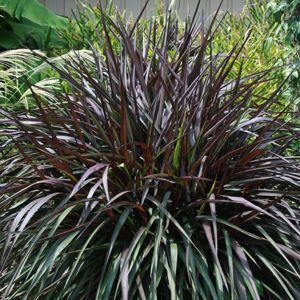 |
| Princess # 1 |
The point is on its way. Don’t go buggy. Last spring, Athens Select Plants, the University of Georgia-Athens’s ornamental plant breeding program, sent me two “new” hybrid purple fountain grasses (Pennisetum purpureum) to try out in my garden. (It’s my favorite garden-writer perq, free plants and seeds to trial. I filled out a 17-packet seed request to Renee’s Garden earlier this afternoon.) Turns out 2010's ‘Princess Caroline’ is essentially identical to 2008’s ‘Princess,’ only more disease-resistant (an ornamental grass susceptible to disease? What moron would buy it if they knew?) and heat-tolerant (a plant only perennial in Zones 8 and up has problems with hot weather?). And ‘Princess Molly’ is yet another virtual (in the literal sense) ‘Princess’ clone, just allegedly four inches shorter. See if you can spot any difference: take our little ID test at right. Correct answers provided below.
 |
| Princess # 2 |
All of these disease-prone, heat-hating purple Princess pennisetums (hort-darling Dr. Allan Armitage calls them “Napier grasses”—those of us in the cheap seats say “fountain grass”) are essentially the same plant. They are the Garet Garretts of the plant-breeding world. They cause a minor splash today, three years pass and, Bob’s your uncle, no one hears of them ever again.
This practice of rushing untested introductions to market really bugs me.
Now, I’ve zigged and zagged from NCSU’s PDIC (aren't acronyms great? So easy to type!) to Norman Rockwell to Cousin F and Garet Garrett to superfluous ornamental grasses. Why? Because as spring approaches, the catalogs and promotional materials from plant breeders are coming thick and fast, and they all tout their newest “discoveries” in the purplest prose. In case you didn’t know, plant patenting has become a big and competitive business. Ask your nearest Monsanto representative. He's lurking somewhere nearby.
 |
| Princess # 3 |
In my neck of the woods, summer bedding-plants start arriving at big-box stores around the end of February. This is a month early, even for our mild climate, but retailers know their winter-weary customers well: if it’s blooming, it sells. Whether it ought to or not.
So the point is (at long last), don’t break the bank for every herbaceous Garet Garrett that grabs your eye with its oversized four-color tag and forced flowers. The percentage of Fitzs' disposable income earmarked for the garden has decreased dramatically over the past several years (thank goodness for those freebies!). If your mad-money pile has shrunk too, the better part of financial valor is to wait a few seasons to see if this year’s trumpeted “next best ornamental since Wave petunias” really is the horticultural equivalent of F. Scott Fitzgerald.
On the other hand, if the recession treated you gently, try them all. (Except those Princess pennisetums. Personally, I’m sticking with good ol’ reliable red fountain grass—P. setaceum var. rubrum—even if we do have to treat it as an annual here.) Hey, one of this year's introductions might be the next Knock Out rose, and then you’ll be ahead of the curve.
In his ever-creative bid to make his wife appear somewhat computer savvy, Tim has taught me how to insert hyper-text links (they're the blue or perhaps green phrases in the text: if you click on them you're transported straight to the appropriate website. That's the theory, anyway). He coached me through putting four of them in this post. In your comments (and I say this with very little hope in my heart), let me know if they actually work. I’ll keep at it until you tell me they’re useless and to please stop.
 |
| Good ol' red fountain grass, with infloresences. That the Princesses don't get any of. |
Thanks for dropping by. I really appreciate it, even if you insist on staying mum about it.
Kathy
Answers to the Princess quiz:
# 1 is Pennisetum 'Princess Caroline' (introduced 2010)
# 2 is Pennisetum 'Princess Molly' (introduced 2010)
# 3 is Pennisetum 'Princess' (introduced 2008)
Kathy
Answers to the Princess quiz:
# 1 is Pennisetum 'Princess Caroline' (introduced 2010)
# 2 is Pennisetum 'Princess Molly' (introduced 2010)
# 3 is Pennisetum 'Princess' (introduced 2008)


