Showing posts with label Toadflax Farm. Show all posts

Monday, June 4, 2012

TRANSITIONS


            About two weeks ago here in southeastern North Carolina, a pleasantly unusual long spring transitioned into summer. I know that because there’s no longer any discussion chez Fitz if the nighttime temperatures and humidity levels might allow both open windows and comfortable sleep: they don’t. As much as I dislike the idea of air-conditioning—artificially controlled climate negating the realities of the natural world—I have to admit I’d really miss it, especially as age has made me less resilient in the heat.

Ralph Waldo Emerson
            (In case you’re wondering, I suffer less of a moral/psychic dilemma over central heating by picturing early man huddled around a smoky fire as the cave entrance fills with snow. And I have no qualms at all about plumbing and electricity—a ten-year tenure in the Girl Scouts taught me more than I absolutely needed to know about living without those particular luxuries. As Ralph Waldo Emerson once remarked, “A foolish consistency is the hobgoblin of little minds,” or something to that effect.)  

*****

Image of 2004's transit of Venus
            An astronomical note:  Venus passes between Earth and the sun on June 5th, causing a visible dot of a shadow to traverse the sun’s disk from west to east.  The first bit of Wednesday’s Transit of Venus can be witnessed from North America as the sun goes down (the entire seven-hour event will be visible from Alaska, where the sun never really sets this time of year). If you’re at all interested, grab this opportunity: your next chance--and I use the second person advisedly--won’t occur until December of 2117.

            Tim and I learned about the transit of Venus from an episode of the third series of BBC’s Inspector Lewis, in which a bon-vivant Oxford don learns he has an inoperable brain tumor, returns to Mother Church, and jilts his long-time mistress, who then accidentally pushes him down the observatory stairs. (It’s a good series, ’way better than the schlock aired on this side of the pond.)

Jeremiah Horrocks observes the transit of Venus
One subplot pivots around Jeremiah Horrocks, the 17th-century British self-taught astronomer and wunderkind (he died at age 22, his best-known achievement a proof that the moon’s orbit around the earth is elliptical), who first systematically observed the transit.  Horrocks’ thumbnail biography on the University of Central Lancashire’s Transit of Venus website tells us “[h]e was able to make three measurements [before the sun set on the village of Much Hoole, near Liverpool] and hence calculate for Venus its Transit path, angular size, and orbital velocity. He derived a value for the solar parallax, smaller than previously recorded, and so concluded that the Sun was further away from the Earth than thought.” Those three measurements also led him to postulate that Venusian transits occur in pairs, eight years apart, and then not again for more than a century (1631 and 1639, 1761 and 1769, 1874 and 1882, 2004 and 2012, 2117and 2125…)  

Some 75 years later, Horrocks’ work led Edmund Halley to call upon the international scientific community to compile their observations of the upcoming 1769 transit so that a greater understanding of the size of the solar system could be reached. Astronomers everywhere heeded Halley’s plea, giving rise to the first ever global collaboration and establishing the foundations of modern science.

All that from watching a little dot float across the sun. Mind-blowing, isn’t it?

*****

Other transitions are happening closer to home. 

What comes to mind when you think of the Bronx? Paul Newman’s grim movie cop in Fort Apache? Miles of blighted urban landscape glimpsed from trains entering and exiting Manhattan’s Grand Central Station? You might want to think again. June 2’s Gardening Gone Wild post tells of an Education for Sustainability partnership between Discovery High School, Rockefeller Center, the Cloud Institute, and visionary George Irwin’s Green Living Technologies (GLTi) that has transformed lives.

I recommend watching the three-minute video of Bronx teenagers planting and installing a green wall at the NBC Experience Store in Rockefeller Center, inspiring stuff at a time educational institutions in this country have lost their compass. When the last school bell rings, where does the current curricular goal of universal but artificially high levels of self-esteem leave kids who can barely read, are innocent of the basic principles of mathematics and science, have only a nodding acquaintance with history, are accustomed to receiving trophies for just showing up, and seem surgically attached to electronic devices? Education for Sustainability (as opposed to education about sustainability) might lead our over-praised, under-educated youth to make visceral connections between themselves, learning and their responsibilities to as well as their rights in the real world.

George Irwin
Gardening Gone Wild quotes Mr. Irwin (who uses as many parentheticals as I do): “The natural progression into education has allowed us to use the Mobile Edible Wall Unit (MEWU) as an educational tool. Celebrity teacher Steve Ritz (Discovery High School, Bronx NY) used the MEWU to improve attendance and achieve close to 100% passing regents scores. He credits the Edible Wall for engaging his students for bell to bell instruction.”

That's good news. Everything else aside, though, I want some MEWUs of my own. They would make nice additions to Toadflax Farm.

*****

Last Thursday's harvest
Speaking of Toadflax Farm, it’s transitioning too. If it doesn’t rain, I have to water everything every other day, the containers daily. Harvests trickle in, a colander-full at a time—tomatoes, peppers, cucumbers, green and wax beans, blueberries, blackberries. The peas have finished, and alpine strawberry yields dwindled down to nothing. It's time to plant the second bean and curcubit crops (which is where those MEWUs would come in handy). The squash and melons I planted on the arbor in the New Bed languished: not enough sun, I believe. Haven’t gotten around to planting the heat-tolerant lettuces yet: if only I didn’t have gainful employment and all my other, decidedly-ungainful-but-fun writing projects requiring time and attention to deal with as well!

Toadflax Farm on May 31
But. The poison ivy rash and accompanying Benadryl-induced stupor are gone for the moment (although I just read about a product applied to exposed skin before going out that allegedly deters urushiol from penetrating skin: I hope it’s not made of tar or bear grease. If I can remember where I saw it, I’ll check it out and keep you posted.) When I move slowly—which is my wont anyway—and take lots of water breaks, I can keep going in the heat. Three of four design jobs are done, presented and paid for. Only two clients still need their summer containers changed out; they’re both on the schedule for this week. I’ve decided on the latest direction the back garden will take, a blue, white and yellow billowy theme, and have almost completed assembling the plant list. Tim bought me a set of Ball canning accessories (head-room gauge and air-bubble popper, wide-mouth funnel, magnetic boiling lid extractor), so my initiation to the wonderful world of air-conditioned hot-water-bath food preservation awaits. My first batches of strawberry and blueberry jams came out runny, but they make yummy ice-cream sauces. Best of all, this spate of activity is forging new neural pathways in my brain, staving off dementia.

It’s all good.

            By the way, if you do plan to watch the transit of Venus, use proper eye protection. Nobody needs burnt retinas.

Thanks for dropping by.

                                                            Kathy

Saturday, April 21, 2012

THE GREAT WALL


Old-field toadflax


            “Let’s call it Toadflax Farm," I said to Tim, "because of the bushels of old-field toadflax I yank out every spring.” (Old-field toadflax is an attractive, airy wildflower/weed with sweet little lavender-blue blooms and a germination rate close to 120%.)

We surveyed our transformed front yard, now a maze of raised beds and Grow-Bags festooned with miles of toe-grabbing bird-netting. The faint dead-animal stench of the soured milk we’d poured on the Grow-Bag tomatoes (for the calcium, that’s why) wafted past on the evening breeze. “More like ‘Green Acres,’” my husband replied.


Toadflax Farm, scoffers notwithstanding
Hmph. My enthusiasm cannot be dampened this early in the season. I go walkabout every morning, camera and harvesting colander in hand, looking for new stuff. Yesterday, almost all the beans had sprouted where the day before only one bent stem could be seen. The peas and strawberries dribble in. (I’ve learned you have to plant a hell of a lot of shelling peas to bring in even a modest crop. I don’t really have the room, so mostly I eat them raw as I pick them.) Baby tomatoes and cucumbers proliferate. Thirty out of 31 peanuts sown are up. The potatoes will need their first hilling this afternoon.

  I am so psyched. I’d rather be puttering around my own yard than working gainfully, or blogging. April, ever one of my favorite months, has outdone herself this year.

*****
Now let’s move on from paean to paving.

Open, flat patios work fine for extending the deck or house out into the garden; they look a bit forlorn, though, when floating on their own out in the yard. Some clients of ours envisioned a curving floored space, complete with firepit, for outdoor entertaining; close to but not abutting the back of the house; and viewable from inside the house. Accordingly, they hired a mason (who managed to pave over only one irrigation head in the process: good thing Tim’s the Leonardo da Vinci of integrated landscape systems). The two-dimensional reality left something to be desired, however. In an attempt to provide the missing j’en ne sais quoi, they tethered the floating patio to the house with a straight and narrow flagstone path at a 94° angle from the bottom step. Didn’t help much.

A friend recommended Fitzgeralds Gardening. When consulted, we suggested a seating wall--so-called because the top of the wall is wide and stable enough to sit on--to enclose the patio, and a wider, more meandering path.

And that’s what we did.

This was in the days before we had a digital camera, so the work-in-progress photos have disappeared into the black recesses of the office closet, probably never to see the light of day again. But I did manage to salvage the before-and-afters for your edification. What a difference a wall makes! 

"Floating" patio
"Floating" patio, grounded


As does the curved as opposed to stick-straight path. (Notice that instead of skirting the clump of three crape myrtles, we routed the path through it. When the trees leaf out, passing among them will make visitors feel more like they’re on their way to a destination. It’s a subtle, subliminal design trick, but it really works.

"Floating" patio tethered better
"Floating" patio tethered, barely


Low walls help define garden rooms, too. One lady asked Tim and me to impose civility on part of her wild-ish back yard, and give her a reason to leave the screened porch. Here’s what we came up with.

Garden room from the rear
Garden room from the front


Low edging wall
Have bermed planting areas that could use some retaining? Need an edging that prevents lawn from creeping where you don’t want it to go? Dream of stopping the lawn guy from slowly decreasing your grassed area by pretending a weed-whacker is an edging tool? A low wall might just be the answer to all these landscaping conundrums. 

Retaining wall, take one:
après ça, le déluge
In this age of proliferating concrete wall-block systems, anyone with a reasonably strong back and knees can build a low wall. I keep emphasizing “low” because anything higher than 18 to 24 inches requires battening. If the word “battening” means nothing to you, don’t plan on going higher than three tiers, four as an absolute maximum. (Wall blocks run to around four inches in height.) For actual retaining walls—designed to hold back tons of soil—hire a professional. Ask for references, and check them. We have a friend who contracted with his mulch provider (?) to install a five-foot high, 115-foot long retaining wall above a pond. The first-time wall builders had no idea they needed to batten such a structure; ergo, the first heavy rainfall toppled several sections and undercut the base in places, because it was improperly done.  

Oh, dear.

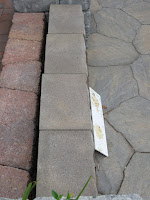
Should you undertake a do-it-yourself wall project, the local home-improvement emporium is a good place to start. (Here are links to the relevant webpages for Lowes and Home Depot.) They stock all you’ll need in the way of materials and tools. Selection has improved tremendously from the days of one-size-fits-all concrete lozenges, with more shapes, colors, finishes (i.e., tumbled, smooth, scored) and price ranges to choose from.
More Lowes wall blocks & pavers
Some Lowes wall blocks & pavers


Paver company catalogs
If you’re not a DYI kind of person, visit a brick- or stone-yard instead. In the Oak Island/Southport area, check out Bianchi’s Brickyard. Proprietor Dave Bianchi is a master mason, which is evident the second you pull up in front of the place. (Those of us who watched it never cease to marvel at the transformation of a nondescript vinyl-sided house set toward the back of a weedy lot to the lovely building and grounds of today.) Tim and I source materials for our projects there, because Dave carries the more up-scale Anchor Block's Holland Pavers (a division of Metromont Materials) and Belgard lines that can be tailored to the particular job, and provides tons (haha) of professional advice.

The orange wall; or, Caveat emptor
Speaking of professional advice, here’s some: choose colors carefully. Err on the side of neutral greys and tans. One client chose the wall block herself for an installation we did. She meant to pick up a subtle pink tone in the bricks of the house, but she didn't have a spare to take with her to Lowes for comparison. Although you can’t really see it in its full glory in this picture, what she got was an orange wall.

*****

Must run. Oak Island, it seems, has lost its deer immunity: my ‘Red Zebra’ baby tomatoes and the top of the plant were gone yesterday morning, and poor ‘Black Trifele’ now nothing but a stalk. So we’re off to Lowes to investigate fencing options. No, a low wall won’t do.

Thanks for dropping by.

                                                                        Kathy

P.S.—Welcome to Laura, décor addict, artist and musician, who arrived as GFTGU’s 15th follower this morning. I’m glad you’re here.