Tuesday, August 9, 2011

OLD DOG, NEW TRICK

            A couple of newspaper articles caught my eye this week. One featured our neighbor, Billy; the other was about a group of women who are learning to read.

            Oak Island doesn’t have any covenanted areas, except maybe Kings Lynn at the far west end. Our street subscribes to the anything-goes school of design, from cinderblock to modular to stick-built on slabs, crawlspaces and pilings. Down the street from us is a cinderblock model surrounded by a chain-link fence with various vehicles in various stages of repair in the yard. We call it “The Compound,” and Billy lives there. He’s a neighborhood character, famous for scavenging anything usable from curb-side deposits. Once Tim and I dug up three hopelessly scaled Burford hollies and tossed them on the lot next door, near the road: Billy salvaged them, and two still live in his yard. When the lady across the street moved, she put some wicker furniture on the curb free for the taking, as is the local custom. Later that day, Tim saw Billy on his moped, balancing the loveseat on his head with the cushions secured to his person.


Our neighbor Billy
            Billy’s middle-aged, and his face reflects his hardscrabble life. The moped transport indicates loss of his driver’s license, in turn indicating a problem with alcohol and/or drugs, and frequent brushes with the law. He’s also friendly, a fount of local knowledge, and quite taken with our garden. (He calls us “the flower people.”) Last week, we were pleased and proud to see him on the front page of the weekly paper upon the occasion of his graduation from drug court, a program for habitual offenders.

            “[T]hat’s my goal [now], to help others,” he’s quoted as saying. “That’s what I want out of this. I’m 50 years old and riding a moped; I’m living with my parents. Thank God for my mama or I might be living under the bridge somewhere. Don’t be like me.” He goes on to give some excellent advice for all of us: “[T]ake the cotton out of your ears and stuff it in your mouth.”

            Billy’s an old dog who’s learned a new trick. Way to go, Billy!


Miss Bobby rehearses
with the Reader's Theatre
(photo by Jeff Janowski)
           On Sunday, Wilmington’s StarNews ran an article on a group of folks who, as part of a  literacy program, have written a screenplay for one of the books they read, and will perform it at a Literacy Council luncheon for 300 people. The program is called Readers’ Theatre; its purpose is to build confidence while improving comprehension and increasing vocabulary. The group inspired one member, Bobby Woods, to work toward earning her high school diploma. When asked what keeps adults from seeking help with reading, she replied, “Pride. Shame. Fear. A lot of people want to read," she went on, “but it’s not in [their] comfort zone. Come out of your comfort zone. Get a new comfort zone.”

            Miss Bobby’s an old dog who learned a new trick. Way to go, Miss Bobby!


One of Momma's quilt tops
as completed by Betty's church group
            Reinventing yourself runs in my family, for good or ill. My dad retired from 35 years as a mechanical engineer for the Navy—he designed ventilation systems for submarines—and, to the amazement of his entire family, started nursing school. A few years ago, my mom’s friend Betty asked her (Momma) for help with piecing together a quilt top for her (Betty’s) church group. Momma had so much fun with the first one that she’s been churning them out ever since, mailing pieced tops from Williamsburg, Virginia, to Houston several times a year. At 84, she’s revitalized.


Three generations of reinventors,
circa 1995: from left,
me, sister Donna, Momma,
niece Abbey, sister Karen, niece Beth
            As a kid, all my sister Karen ever wanted was to be a mom. Thirty seconds after taking her degree in Home Economics from Virginia Tech, she married Rob and had Abbey. Beth and Robbie arrived in due course.  She home-schooled all three kids and helped her husband with his tax preparation business for over two decades. When the youngest child finished college, Karen shocked us all by going back to school herself, to study engineering. The birth of Abbey’s first set of twins (the second set followed 18 months later, a reinvention in itself for a girl with her masters degree in teaching English as a second language) put a temporary halt to Karen’s science education; but I have no doubt she’ll finish what she started.

            (In case you’re wondering what the “ill” part is, my older sister reinvented herself homeless five or six years back. She’s better now.)

            Old dogs, new tricks.

            When we started in the business, neither Tim nor I had any formal horticulture credentials. (Thirteen years on, we still only have one, certification as North Carolina Professional Plantsmen.) He quit his job with the State Department, and I quit mine as a housewife, to run away to North Carolina from New York. (How we ended up on Oak Island is a lovely, romantic story. Details available upon request.)

The first time we went to a wholesale nursery to buy plants for a job, I broke down in the conifer section and started to cry. “They’ll know we’re not really landscapers,” I blubbered. Tim picked me up off the ground (I’d tripped over the cart hitch) and looked me in the eye. “We have cards that say we’re landscapers, so we’re landscapers. We can be anything we want to be. The only school that really matters in the end is the on-the-job one.”

That was the day this old dog learned a new trick. I’ve never looked back.

In the wild, humans don’t have much going for them. We’re weak, furless, clawless, poor diggers, sad swimmers, pitiful runners and worse climbers—not a great recipe for success in nature. But we are fantastic adaptors, and the ability to turn disadvantage into something we can use for our own ends is what we’re best at. Just look at any friggin’ politician.

I know, I know. Thanks for the sermon, Reverend Weird, you’re thinking. But what have dogs doing tricks got to do with gardening?  


Miss Frizzle
            This: last Thursday, after three seasons of disappointments and dashed hopes, Tim and I shared our first-ever home-grown, picklewormless cantaloupe. I’m saying that if I can do it—successfully thwart pickleworm moths—you can do it—gardening, or anything else—if you really want to. I’m saying it’s freeing to learn something new, to do something new, to be something new. The course of your garden or your life isn’t graven in stone. Miss Frizzle of Magic School Bus fame said it best: “Make mistakes! Get dirty!”

Consider joining old dogs Billy, Miss Bobby, my family and me: teach yourself a new trick. I can testify, it feels great.

Thanks for dropping by, you old dog, you.

                                                                        Kathy

P.S.-- If you missed the wonderful Magic School Bus books, do peek at the website linked above.

Scholastic's Magic School Bus gang

Friday, August 5, 2011

WILDFLOWER / WILD FLOWER

            “A plant in the wrong place” is probably the best thumbnail description of a weed I’ve come across, avoiding as it does the whole value-judgment, hierarchical, holier-than-thou vortex. Let’s put this weed identification series to rest by looking at some plants that flummox any such neat categorization attempts.

            I’ll provide minimal commentary. You judge for yourself. There are no right answers.

WILDFLOWERS

            Here are nine specimens that grow wild—meaning without any initiation or intervention from me—in our yard or in the vacant lot next door. Most are well-behaved, and stick to their niches. Usually. (Click on the pictures to enlarge them.)

Bushy aster (Aster dumosus)
I like this white-blooming perennial, but have a soft spot (and a collector’s eye) for all asters. I’ll probably do a whole post on the genus come September. But I won’t call them Symphyotrichum, even if the Taxonomy Police show up at our front door.


Butterfly pea (Clitoria mariana)
In my book, most members of the leguminous Fabaceae (pea) family are garden-worthy. This one’s quirky beauty has to seen up close to be appreciated.


Goldenrod (Solidago speciosa)
A classic fall perennial, and with good reason. The wild version flowers more prolifically and returns more reliably than any hybrid I’ve tried.


Sundrops or Cutleaf evening primrose (Oenothera laciniata)
Blooming from early to mid-spring, annual evening primrose’s cup-shaped lemon-yellow flowers are a welcome sight. But I wouldn’t have its pushy pink perennial cousin, showy evening primrose (O. speciosa), in my garden on a bet.


Prickly pear cactus (Opuntia humifusa)
Cactus aren’t my thing, even perennial natives like prickly pear. The leaves—because that’s what the pads are—don’t rock my boat. But I waver when flowers and fruit appear. Still, not a good choice for barefoot gardeners.

Prickly pear pads and fruit

Prickly pear transformed


Purslane (Portulaca oleracea)
Succulent purslane is the wild cousin of the highly hybridized bedding plant, portulaca. Both are annual; purslane is by far more understated. Thanks to my friend, Chuck, for the picture of his marigolds overtaken by a stand of purslane.
 
Marigolds overrun by purslane
 
Understated purslane flower


Slender bush clover (Lespedeza virginica)
This native relation of Chinese Lespedeza thunbergii (see “Enter Field Notes,” posted June 12, 2011) produces poufs of white-and-lavender flowers in its leaf axils beginning in late summer. Personally, I’m a fan of all things lespedeza.


Sneezeweed (Helenium amarum)
Sunny annual cousin to the many hybridized sneezeweeds. Clumps of low-growing, taprooted, golden yellow flowers appear on road verges in July, and continue blooming into October most years.


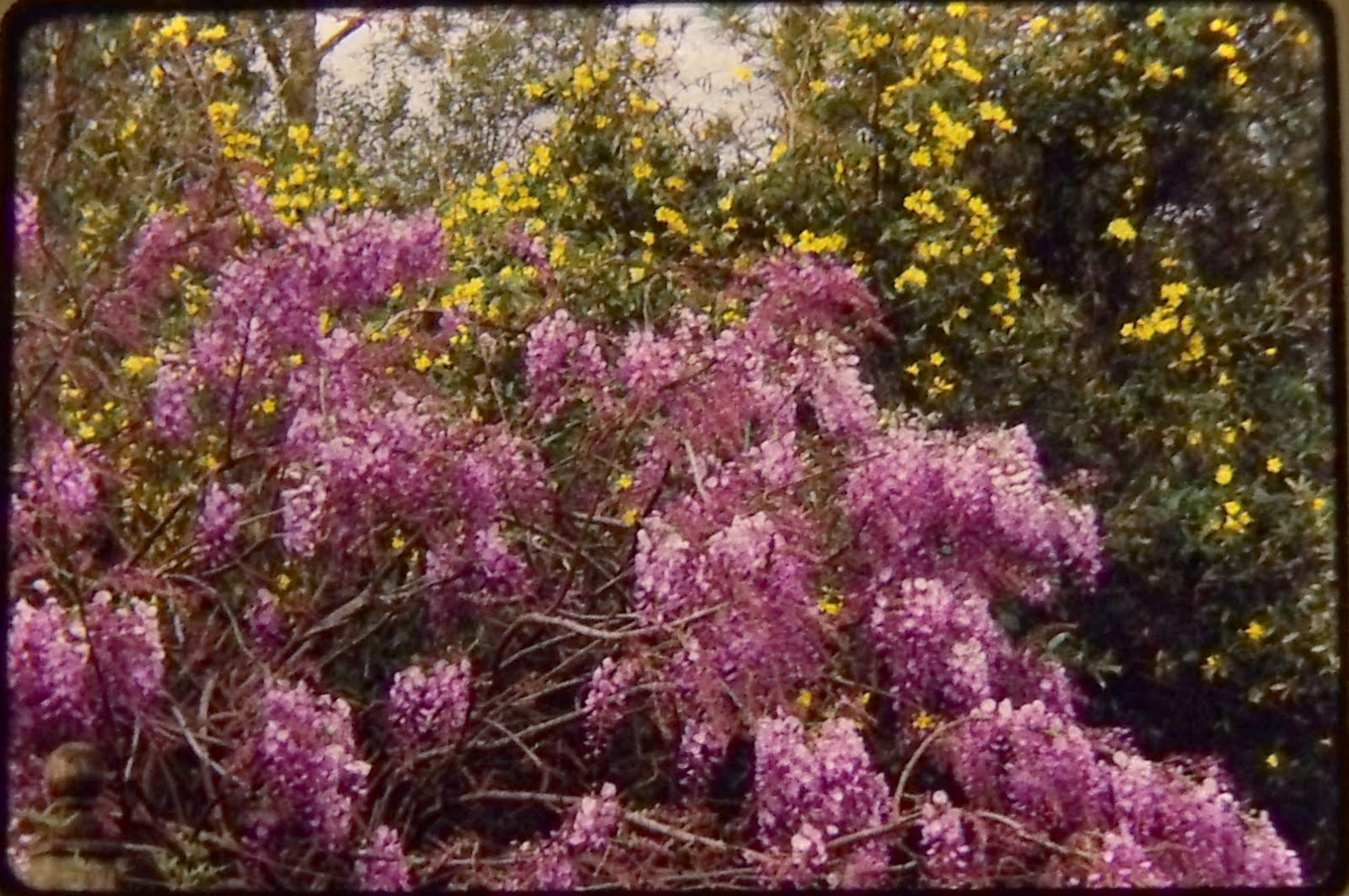
Wild jessamine crowns my wisteria
Carolina jessamine (Gelsemium sempervirens)
This evergreen native vine threads its way up trees, cunningly climbs fence posts and snakes along the ground for hundreds of yards (it seems). I snip off terminal ends and pull out runners that make forays into my yard, but glory in the cascades of yellow trumpet flowers produced in late winter and early spring in the vacant lot adjoining our property.


WILD FLOWERS
           
Moving right along, I offer eight cultivated perennials that have weed/wildflower parents whose wild origins and habits have not been reliably overcome.

Tickseed (Coreopsis grandiflora, C. lanceolata)
You can generally count on coreopsis hybrids to be well-behaved, but watch out for the straight species. My experience has been that their seed-germination rate is in excess of 100%.


Bee balm (Monarda didyma)
Whiskery flowered bee balms and their cousins, the eastern horsemints (M. punctata var. punctata), have well-deserved reputations for spreading by rhizome far beyond their allotted spots in gardens. At least you can contain them by planting in  sunken pots.

Eastern horsemint, a.k.a.
wild bergamot

Monarda didyma, parent of most
ornamental bee balms


Hardy or Texas ageratum (Eupatorium coelestinum, now called Conoclinium greggii)
A perennial lookalike of annual floss flower, this autumnal blue-bloomer also spreads aggressively by rhizome, something I didn’t know until its second season in my garden. Took me two more years of grubbing out shoots to eradicate it completely.


Spiderwort (Tradescantia virginiana)
Spiderwort’s another candidate for planting in a pot to contain its propensity to wander. The volunteer shown here descended from a gold-foliaged T. x andersoniana ‘Sweet Kate’ that reverted to its T. virginiana parent-type. It’s nowhere near the original plant.


Carolina petunia (Ruellia carolina)
This sweet blue flower hides a megalomaniacal secret: it’s out to conquer the world by seed as well as rhizome. After six years of trying to keep it where I wanted it to stay, I’ve given up and let it naturalize throughout the yard.


Japanese knotweed (Polygonum cuspidatum)  
This clump-forming thug came home with me, at great cost, from one of Plant Delights Nursery’s Open Houses. I keep it in bounds (barely) by whacking at it constantly during the growing season, using lots of masons twine, and trying to remember to deadhead before seed-set. Why do I keep it? Tim loves the flowers.


Trumpet creeper (Campsis radicans)
This smothering native beauty grows with wild abandon in the woods and waste places of southeastern North Carolina; but every ‘Madame Galen’ hybrid I’ve planted on purpose has died. It’s comforting, in a way, to have proof that not everything bends to man’s will.


Maypop (Passiflora incarnata)
I have to confess that I love this native annual vine. Like wisteria, to me it’s worth the trouble it causes. But if you opt to install passionflower in your yard, you should know I’ve pulled up 175 volunteer seedlings so far this season, mostly from our yard, but also from the neighbors’. Don’t say I didn’t warn you.

Why I put up with maypop

Three of this year's 175
seedlings (and counting)


            Okay, kids, I’m tired of talking (and talking and talking) about weeds for a while. I know there's a useful book in all this verbiage: nonetheless, we’ll change the subject next time.

            Thanks for dropping by.

                                                                                    Kathy

Monday, August 1, 2011

VINES WE LOVE TO HATE... OR NOT

The amorphous malaise continues. Maybe I’ve developed a sensitivity to increased atmospheric carbon dioxide. Regardless of what my problem is, burgeoning CO2 levels makes vining plants very happy indeed. In 2007, USDA scientist Lewis Ziska published a study in Weed Science saying that, since the 1950s, vines grow more vigorously and spread with devil-may-care aplomb; they’re harder to kill; and, most ominous of all, the effects of the itchy-rashy substances in the skin-irritating ones are magnified.  If you’ve battled any of the following in your yard, you know he's right.

Poison ivy counts as the worst offender by my reckoning. Urushiol, the chemical that causes the irritation, rash, blistering, oozing and itch, is present in the leaves, stems, woody parts and roots. It remains active even after the plant dies. Some hyper-sensitive unfortunates even react if exposed to the smoke of burning poison ivy, developing lesions in their mouths, noses, throats and lungs. Can you imagine?

Poison ivy, with leaves of three
Toxicodendron radicans
            Growing up in the swamps of southeastern Virginia provided opportunities aplenty for close encounters: Girl Scout Camp Skimino was redolent with the appropriately named Toxicodendron radicans (the genus translates to “poisonous wood”). My dearest childhood friend, Ginny Black, had only to pass within 30 feet of a strand to start scratching. Because children are cruel, all of the urushiol-invulnerable Scouts giggled at her misery. In those days, I could roll in the stuff and suffer no ill effect.  The day I turned 50, however, my immunity switched off. If balance exists in the universe, as I believe it does, Ginny’s curse disappeared around the same time, and she gets the last laugh. Fifteen to 30% of people are completely immune: the rest suffer at differing times in their lives (like Ginny and me) and with differing intensities.

More deeply lobed poison oak leaflets
Toxicodendron pubescens
Regarding poison ivy, our Scout handbook taught us the ditty, “Leaves of three, let it be.” This is sound advice for the fearful, akin to “Better safe than sorry.” One of life’s little ironies, it’s easier said than done for those gathering wood for the campfire, and for those laboring in gardens of their own or others. Learning to recognize plants that contain urushiol is the best defense. The three commonest offenders are poison ivy, Atlantic poison oak (Toxicodendron pubescens), and poison sumac (T. vernix). I include pictures of all of them here, and links to websites with more information.

Poison sumac doesn't follow
the "leaves of three" dictum
Toxicodendron vernix
Southeastern North Carolinians only need worry about the first two: mercifully, poison sumac doesn’t grow here. I say “mercifully” because the “leaves of three” dictum doesn’t apply. Poison sumac looks like, well, non-poison sumac. Poison oak is indigenous to the south, ranging from New Jersey to Kansas, and south to Florida and Texas, except for Pennsylvania, Ohio, Indiana and Kentucky. Go figure. Poison ivy is native to all of North America east of the Rockies plus Arizona, but not in New Mexico, North Dakota, Newfoundland and Labrador.

Why is there poison ivy? Non-human animals seem urushiol-proof: many eat it with gusto, and the berries are a great favorite of many birds. Another sorrowful mystery for the books. For rash palliatives, go to December 10, 2010's post, "Stuffing Stockings." 

I’m starting to itch, so it’s time to move on to less painful but just-as-vigorous vining plants liable to turn up in your yard.

Virginia creeper creeps
up a tree in a vacant lot
Parthenocissus quinquefolia
Virginia creeper (Parthenocissus quinquefolia) often gets mistaken for poison ivy because seed leaves have three leaflets instead of the characteristic five of older foliage. Native to eastern and central North America, it can actually be purchased and planted on purpose as an ornamental vine, mainly due to its brilliant red fall coloration. A vigorous climber—up to 30 feet—it attaches itself to supports by means of flat discs at the end of its tendrils. The problem with creeper is that it pops up unbidden EVERYWHERE in my neighborhood. And while it doesn’t strangle the trees it obscures, its exuberant growth tends to smother them to the point of inhibiting photosynthesis. I’m just sayin’.


            Kind of like kudzu. Kudzu (Pueraria lobata) is the poster child for non-native invasive plants. (The whole native/non-native, invasive vs. biodynamic issue will be the subject of a future post.) We don’t see a lot of it very near the coast—salt may affect it adversely—but it’s certainly ubiquitous inland, where it out-competes anything else, including slow-moving creatures. Kudzu is probably the reason there are no North American sloths. It primarily spreads by shooting out above-ground stolons and sub-surface rhizomes. I include a picture of its pretty though inconspicuous flower. Allegedly, the fruits make scrumptious jellies, and fragrant soaps and lotions. Originally imported from Japan as a fast-growing, adaptable bovine fodder, when agribusiness decided to start raising cattle in concentrated feedlots and force-feeding them grain instead of the forbs they’d rather consume, there weren’t enough pasture-raised cows left to eat what kudzu had been planted. The rest—along with mad-cow disease and rising growth-hormone levels and antibiotic resistance in humans—is history.

The lovely kudzu flower

Kudzu doing its thing
Pueraria lobata


Another rampant vine of southeastern landscapes is the scuppernong grape (Vitis rotundifolia). The oldest cultivated grape in the U.S., the 400-year-old “Mother Vine” still grows on Roanoke Island, NC. A variety of Muscadine, scuppernong can be found in the wild all over the South. I transplanted a specimen from the vacant lot next door to our outdoor shower, hoping for future harvests. Scuppernong grapes are an acquired taste, as they have seeds and bitter skins. Scuppernong grape vines are notoriously difficult to get rid of once they establish a foothold where you don’t want them. The woody vines don’t pull out easily, and the roots of all of them, it’s rumored, extend back to the mother plant just outside of Manteo.

Transplanted scuppernong vine
takes hold on our outdoor shower

Scuppernong grape vine
making itself at home
Vitis rotundifolia


Bramble blackberry vine in situ
Rubus vulgaris

You can’t catalog miserable vines with edible fruits without mentioning good ol’ Rubus vulgaris, the bramble blackberry briar. Bramble blackberry is a weed of cultivation, appearing in disturbed soils. Spreading by rhizomes to form impenetrable thickets, it guards its delectable fruit by skazillions of evilly hooked thorns. I know of a large patch (the location of which I reveal to no one), and am willing to accept the blood-sacrifice required to harvest the small, intensely flavorful berries. This is not a plant I want in taking hold in my yard, however. Intruders get summarily yanked out as soon as I spot them, such as the one pictured here.


Close up  of bramble blackberry vine
at left, pulled out of the ground


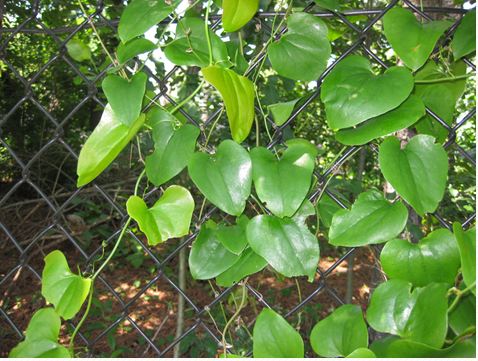
Cat brier,
a.k.a roundleaf greenbrier
Smilax rotundifolia
(Note lack of thorns and
 heart-shaped leaves) 
Cat briers get the same treatment, only with less happy results. Sometimes known as greenbrier, Smilax spp. is a native of southeastern and central states, roughly similar in range to poison oak. Its most common name derives from the cat-claw-like thorns clothing the stems. You can also call it carrion flower, because, dependent on flies for pollination, its blooms stink like, er, dead things. Fortunately for us, they’re inconspicuous. Familiar species include S. bona-nox (saw greenbrier) and S. rotundifolia (roundleaf greenbrier), pictured here.  Cat brier’s apparent immortality arises from the woody tuber at its base. These tubers, notoriously difficult to dig out given their propensity to intertwine with the roots of desirable plants, can reach the size of russet potatoes. Tim and I knew a guy who carved whimsical animals and such out of them: he certainly didn’t have to worry about running out of raw material. (There's a good picture of a typical tuber at http://www.davesgarden.com/guides/pf/go/94170. Click to view all nine photos at left; click again to enlarge the shot by Podster. I can't use it without authorization, and I don't want to piss Dave off.) The more enterprising among you may be pleased to learn that Smilax tubers are the source of sarsaparilla (not “SASS-parilla,” as I’ve always heard it said), if you want to go to the trouble of excavating them. Some Smilax species have smaller thorns, or none at all. These latter occasionally turn up in the trade as an ornamental vine. I can only shake my head in disbelief.
   
Cat brier,
a.k.a saw greenbrier
Smilax bona-nox
(Note thorns and
 silvery blotches
on arrowhead-shaped leaves)

 And no, I don’t know why it’s spelled “brier” instead of “briar.”

To rid your landscape of any of these vines, I recommend pulling. And pulling. And pulling. None of them have roots that pop readily out of the ground, so what you’re trying to do is starve them to death by depriving them of the ability to photosynthesize. It takes a while, but it works. It is also the most sustainable and environmentally responsible control method out there. Roundup doesn’t work on woody plants (regardless of what Monsanto may have led you to believe), so don’t bother.

The problem with vast empty spaces has raised its ugly head again. If anyone knows how to fix it, or avoid it, please clue me in.

Well, that’s enough for today. My deepest, sincerest apologies to the Sondeys, in whose yard we were supposed to be working today. I swear, we’ll be there tomorrow.

To the rest of you, thanks for dropping by.

                                                                        Kathy